
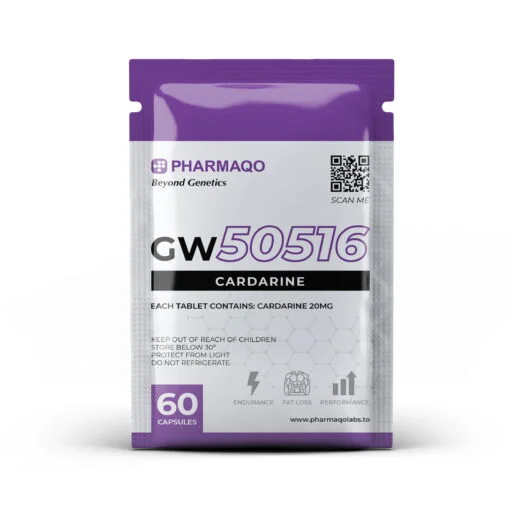
Cardarine GW50516
$70.00
Cardarine GW-501516 Advanced Endurance and Fat Metabolism Research Compound
Cardarine GW-501516, also known as GW-50516, is one of the most extensively studied compounds in endurance, fat metabolism, and performance enhancement research. Though often categorized alongside SARMs, Cardarine is technically a PPARδ receptor agonist — not a SARM — making it a distinct and highly valuable tool for exploring energy regulation, stamina, and lipid metabolism in scientific studies.
At Pharmaqo Labs Shop, our Cardarine GW-501516 is manufactured under pharmaceutical-grade standards for exceptional purity, stability, and research precision, ensuring consistent, reproducible results in every study.
What Is Cardarine (GW-501516)?
Cardarine, or GW-501516, was originally developed to investigate metabolic disorders and cardiovascular health. It works by activating the PPARδ (Peroxisome Proliferator-Activated Receptor Delta) pathway — a powerful mechanism responsible for controlling the body’s fat metabolism, energy expenditure, and endurance response.
By influencing how the body utilizes fatty acids, Cardarine enhances aerobic performance and fat oxidation, making it a prime research candidate for studying energy balance and athletic capacity.
Key Benefits Observed in Research
-
Increases Endurance and Stamina: Promotes efficient energy utilization during aerobic activity.
-
Enhances Fat Oxidation: Encourages the body to burn stored fat as a primary energy source.
-
Supports Muscle Preservation: Helps maintain lean muscle mass during caloric restriction.
-
Improves Lipid Profiles: Reduces LDL cholesterol while promoting healthy HDL levels.
-
Boosts Recovery and Energy Efficiency: Optimizes mitochondrial function for sustained performance.
These properties make Cardarine GW-501516 one of the most effective compounds studied for endurance and metabolic optimization in both human and animal models.
Mechanism of Action
Cardarine operates through the PPARδ pathway, which regulates genes involved in fat metabolism and energy balance. Activation of this receptor enhances fatty acid transport and oxidation, leading to improved energy output and muscle endurance.
In studies, this mechanism resulted in:
-
Increased time to fatigue during exercise
-
Reduced glucose utilization (shifting energy reliance to fat)
-
Enhanced oxidative capacity in muscle fibers
This makes Cardarine a valuable compound for researchers studying metabolic efficiency, endurance adaptation, and athletic performance.
Suggested Dosage & Usage (For Research Purposes Only)
Pharmaqo Cardarine GW-501516 is provided for scientific and laboratory research use only.
Typical research dosage range:
-
10–20mg daily for 6–8 weeks (depending on the study objective).
Stacking potential:
-
For endurance research: Often combined with Stenabolic (SR-9009) for enhanced mitochondrial activation.
-
For recomposition studies: Commonly paired with MK-2866 (Ostarine) or LGD-4033 (Ligandrol) to maintain muscle mass while promoting fat loss.
Important: Cardarine is not a SARM and is not approved for human use. It is strictly intended for research and educational purposes.
Pros and Cons
Pros
-
Strong effect on fat metabolism and energy efficiency
-
Improves cardiovascular and muscular endurance
-
Protects muscle tissue during a calorie deficit
-
Non-hormonal — no testosterone suppression
-
Ideal for long-term endurance and metabolic research
Cons
-
For research use only — not approved for medical or human application
-
Long-term toxicity data are limited
-
Requires precise dosing for reliable study outcomes
Cardarine is widely recognized as one of the most reliable non-steroidal performance-enhancing compounds in the field of metabolic and endurance research.
7 reviews for Cardarine GW50516
Add a review
Related products
Brooks (verified owner) –
Cant beat the price
Jedediah (verified owner) –
super
Ebba Cruddace (verified owner) –
super
Quentin (verified owner) –
Will definitely buy again
Devlen (verified owner) –
Exactly what i was looking for.
Sander (verified owner) –
Definitely reccommend
Elwyn (verified owner) –
Bought as a gift, they loved it